
SERVICE DESIGN · WEBSITE DESIGN · CONCEPT
Passport
Making passport applications clearer.
A service and website concept to help applicants understand requirements, prepare documents and plan their visit.
PASSPORT GUIDANCE · CONCEPT
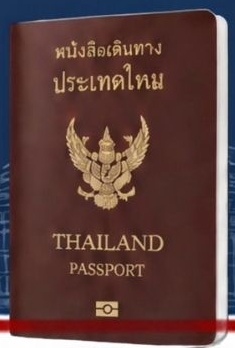
Apply for a Thai passport
Find relevant guidance and prepare for your appointment.
What documents do I need?
Your age
Adult / Under 20
Your application
Renewal / Lost passport
Your situation → Your checklist → Next steps
Illustrative interface — requirements to be verified.
01
The Challenge
Passport applicants need to understand which requirements apply to their circumstances, prepare the right documents and know what happens during and after their appointment.
This concept explores how clearer guidance can support the wider consular service journey.
How might we help applicants prepare with greater clarity?
02
Research
Proposed research: review recurring applicant enquiries, audit existing website guidance and speak with applicants and frontline staff. This section will be revised with the evidence and methods used in the project.
Applicant enquiries
Identify common questions and points of uncertainty.
Content audit
Review information structure, terminology and readability.
Staff perspectives
Understand document checks, exceptions and service dependencies.
03
Key Insights
Working hypotheses to validate through research.
Relevant requirements
Applicants need guidance that reflects their circumstances.
Clear next steps
People need to know what to do after preparing their documents.
Preparation confidence
Scannable guidance could reduce uncertainty before the visit.
Connected touchpoints
Website guidance should connect with appointments and in-person support.
04
From research to structure
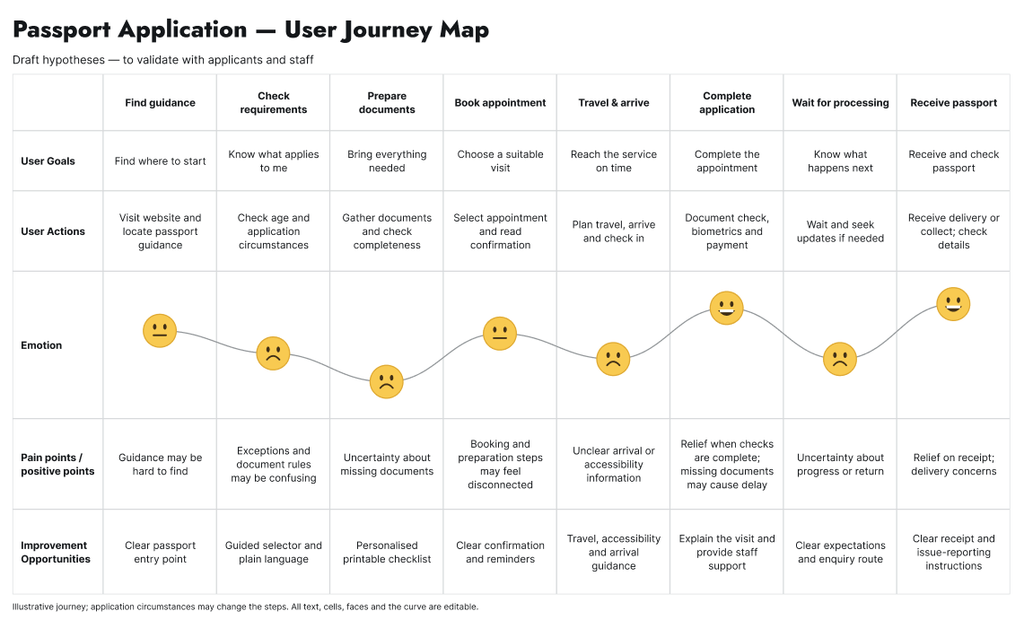
Initial service mapping connects the applicant-facing experience with staff activities. These are illustrative starting points to refine with research.
01 / Applicant journey
Discover
Find information
Prepare
Check requirements
Book
Arrange a visit
Visit
Attend appointment
Receive
Delivery or collection
(user journey)
02 / Service blueprint
Applicant actions
Find guidance → Prepare → Attend → Receive
Frontstage
Website guidance, enquiries and appointment support
Backstage
Document checks, processing and dispatch coordination
A detailed blueprint will be added after validating the process and handoffs.
05
Design direction
Show relevant documents
Organise guidance around applicant circumstances.
Explain the next step
Provide clear preparation and appointment instructions.
Make guidance scannable
Use plain language, short sections and accessible hierarchy.
Prototype – Passport Application guide with selectors
What do I need for my Thai passport application?
Answer a few questions to see the documents and instructions relevant to your situation.
What are you applying for?
06
Explore the Design
Annotated lo-fi
(Lofi)
Find out what you need
01 Your situation
02 Document checklist
03 Next steps
(Wireframe concept)
High-fidelity direction
A clearer interface that helps applicants find relevant guidance.
(Hifi)
PASSPORT GUIDANCE · CONCEPT
Apply for a Thai passport
Find relevant guidance and prepare for your appointment.
What documents do I need?
Your age
Adult / Under 20
Your application
Renewal / Lost passport
Your situation → Your checklist → Next steps
Illustrative interface — requirements to be verified.
The interfaces shown here are editable visual concepts, rather than a working passport application tool.
07
Reflection
The concept connects the wider passport application journey with clearer website guidance. The next step is to validate the content and interactions with applicants and staff, then refine the design.
Expected benefits include better preparation, fewer avoidable enquiries and clearer next steps. These have not yet been measured.